 PostgreSQL
 Azure Synapse
 ClickHouse
 DuckDB
 ekai raises $1.7MBacked by Misneach and C10 Labs. Yahoo Finance ↗

Build trusted data products in hours.
For a new business need, with data spread across systems.
Illustration · demo data
 See how ekai worksBook a demo
One verified set of definitions.
Launch data products in hours, give AI agents answers you can defend, and switch platforms without losing the business logic.

 Systems of record



 Docs and knowledgeRead directlySystems of intelligence


 General purpose agents
 ToolsData platform agents
It profiles your warehouse in place, asks your experts only what the data can't explain, and ships governed semantic models and production dbt pipelines. Every answer comes from one declared definition, with a record of who declared it.
For a new business need, with data spread across systems.
One semantic model, so every agent answers the same way.
Migrate rebuilds legacy semantic models on your new warehouse.
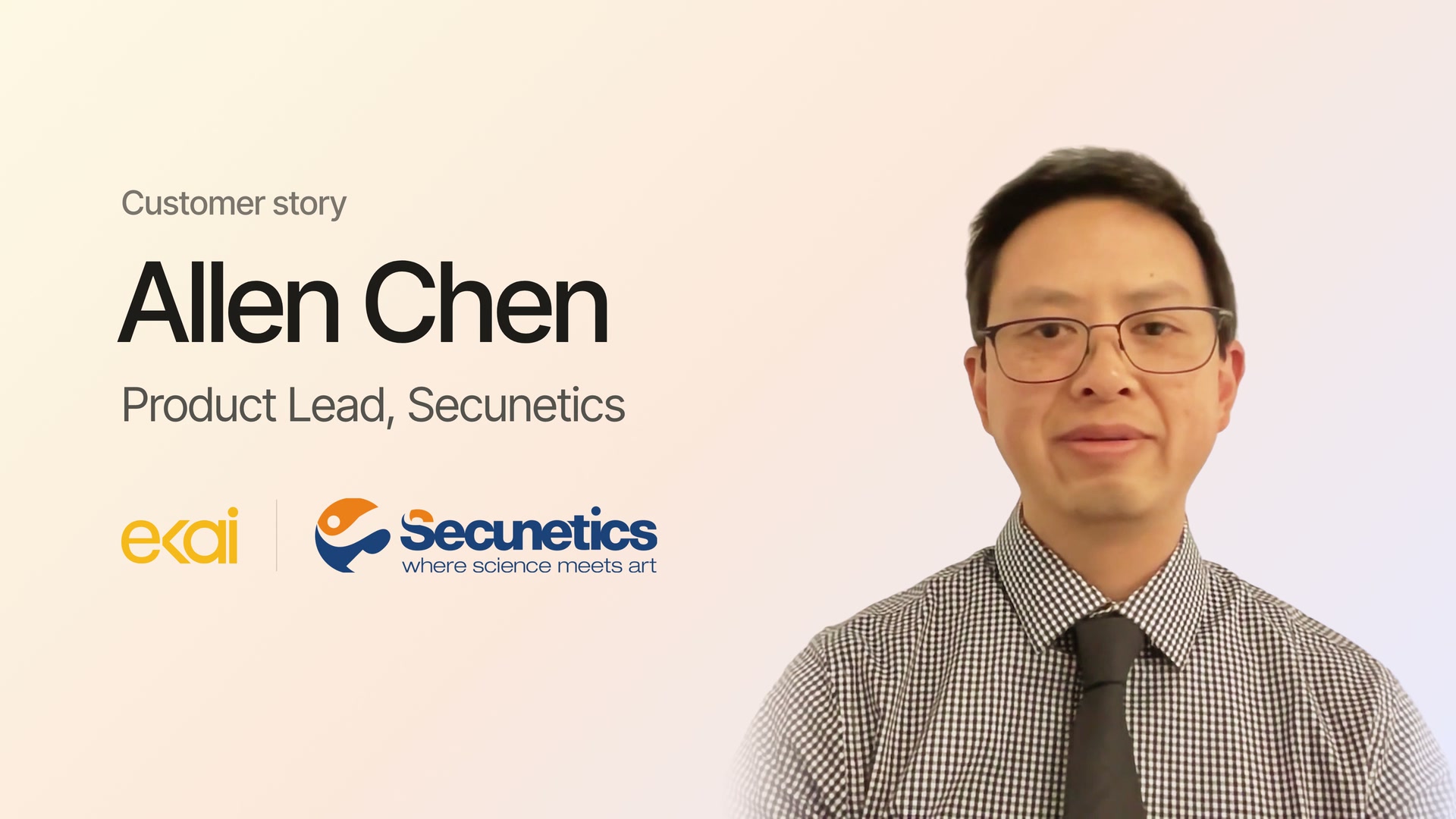
Allen Chen, Product Lead at Secunetics, in his own words.
ekai removes the bottleneck, so data products go from an idea to production in hours, not months, turning your data and expert knowledge into business context for AI.
A lot of AI projects are failing because enterprises do not have production-ready semantic models in place.
ekai profiles your warehouse, captures the knowledge that lives in your business users' heads, and gets your data ready so your AI agents can work in production.
 Mo AidrusCo-founder and CEO, ekai
ekai learns your business from your experts, then proves it. A lot of AI projects are failing because enterprises do not have production-ready semantic models in place. Now, in order to get that, that requires automatic semantic modeling at the heart of what ekai does. ekai profiles your warehouse, captures all the tribal knowledge that exists in the heads of your business users, and then gets your data ready so that your AI agents can actually work in production.
Every answer comes from a declared definition. Anything outside the model comes back as a gap.
Send the right page to the right person.
Every number has a definition and an owner, and every tool agrees.
→See ekai for CDOsFor data engineersCode, tests and documentation land in your Git and dbt, ready to review.
→See ekai for engineersFor applied AI engineersekai publishes each verified semantic model to the agent platform your team builds on.
→See ekai for applied AI engineersA semantic layer is your company's definitions written down in one governed place, such as what counts as revenue or an active customer, so every tool and AI agent reads the same meaning. Without one, three AI tools asked for last quarter's net revenue can return three different numbers, because each one guesses the definition. ekai builds that semantic layer for you: it profiles your warehouse, captures your experts' definitions and publishes verified semantic models to your AI agents.
Your AI gives different answers because the definition behind the number was never written down, so it guesses what a term like net revenue means each time it is asked. ekai stops the guessing: it turns your expert's answers into one verified definition, checks it against your warehouse, and every tool reads the same one.
Because AI is probabilistic, so asked the same question twice it can work out two different numbers. ekai keeps the calculation deterministic: your warehouse calculates every number from a governed definition, the same way every time, and AI uses that number to reason, explain and answer in plain language.
Yes, for the data work. A forward deployed engineer, or FDE, is the engineer a vendor sends in to wire AI into your data: profiling tables, mapping how they connect, interviewing your experts and writing the definitions. That usually takes three to five months. ekai automates it end to end on top of your warehouse, without an FDE.
ekai takes a data product from an idea to production in hours, not months. About 90% of traditional time to value goes to manual data and context engineering: discovery and profiling, relationship mapping and the business rules and definitions, which is the work ekai automates with your experts. A full end-to-end discovery and semantics workflow takes 4 to 6 hours at minimum with ekai. Secunetics built a fully documented dbt pipeline with ekai in 6 hours.